

RESUMEN
La Inteligencia Emocional (IE) ha emergido como un pilar fundamental en la educación universitaria, vinculándose con el rendimiento académico, la adaptación social y la empleabilidad. Sin embargo, escasean estudios empíricos que midan su impacto comparativo entre instituciones y su papel relativo dentro del Capital Intelectual (CI) de los estudiantes. Este estudio aborda esa brecha mediante el análisis de la IE en 1.923 estudiantes y egresados de cuatro universidades chilenas (UTEM, Usach, UCH, UBO), utilizando el instrumento validado Tecer-2012 y los modelos operativos IEom2/ICom2 para cuantificar el Capital Emocional (CE), el Capital Relacional (CR) y el Capital Cognitivo (CC) como componentes del CI.
Mediante técnicas multivariadas (análisis de conglomerados, componentes principales y análisis discriminante), se identificaron dos perfiles estudiantiles: uno con alto desarrollo emocional-relacional (54% de la muestra) y otro con competencias emocionales rezagadas (46%). Los resultados revelan que el Capital Emocional es el predictor más fuerte del Capital Intelectual global (β = 0,50; p < 0,001), incluso superando al capital cognitivo (β = 0,22). Asimismo, se observaron diferencias significativas según género (mujeres > hombres en IE, p < 0,01) y según etapa académica (estudiantes avanzados > principiantes, p < 0,01).
A nivel institucional, aunque no se hallaron diferencias significativas en la IE global (p = 0,053), la Usach destacó con las puntuaciones más altas en CE (51,85) y CC (82,27), lo que sugiere un entorno que potencia simultáneamente los aspectos cognitivos y emocionales. En contraste, la UTEM mostró fortalezas en CR (57,09), pero niveles más bajos en CC (71,15), indicando un perfil más socioemocional.
Estos hallazgos demuestran que la IE no es un complemento, sino un catalizador del capital intelectual estudiantil. Las universidades deben integrar formalmente el desarrollo de competencias emocionales en sus planes de estudio, especialmente durante el primer año, para cerrar brechas y potenciar el desempeño integral. Este estudio ofrece un marco empírico y metodológico replicable para transformar la educación superior hacia un modelo verdaderamente holístico.
ABSTRACT
Emotional Intelligence (EI) has emerged as a critical pillar in university education, relating to academic performance, social adaptation, and employability. However, there is a lack of empirical studies that measure its comparative impact between institutions and its relative role within students’ Intellectual Capital (IC). This study addresses that gap by analyzing EI in 1,923 students and graduates from four Chilean universities (UTEM, USACH, UCH, UBO), using the validated TECER-2012 instrument and the IEom2/ICom2 operational models to quantify Emotional Capital (EC), Relational Capital (RC), and Cognitive Capital (CC) as components of IC.
Through multivariate techniques (cluster analysis, principal components, and discriminant analysis), two student profiles were identified: one with high emotional-relational development (54% of the sample) and another with lagging emotional competencies (46%). Results reveal that Emotional Capital is the strongest predictor of global Intellectual Capital (β = 0.50, p < 0.001), even surpassing cognitive capital (β = 0.22). Additionally, significant differences were observed by gender (women > men in EI, p < 0.01) and by academic stage (advanced students > novices, p < 0.01).
At the institutional level, although there were no significant differences in global EI (p = 0.053), USACH stood out with the highest scores in EC (51.85) and CC (82.27), suggesting an environment that simultaneously enhances both cognitive and emotional aspects. In contrast, UTEM showed strengths in RC (57.09) but lower levels in CC (71.15), indicating a more socio-emotional profile.
These findings demonstrate that EI is not a complement, but a catalyst for student intellectual capital. Universities must formally integrate emotional competency development into their curricula, especially in the first year, to close gaps and enhance comprehensive performance. This study provides a replicable empirical and methodological framework to transform higher education toward a truly holistic model.
Introduction
In a world characterized by uncertainty, complexity, and interconnectedness, technical competencies alone are no longer sufficient to guarantee success. Emotional Intelligence (EI), defined as the ability to recognize, understand, regulate, and effectively use one’s own emotions as well as those of others, has emerged as a critical factor in adaptability, resilience, and effective leadership.
Within the university context, where professional success is no longer measured solely by technical mastery but also by the capacity to lead, collaborate, and adapt, Emotional Intelligence has ceased to be a “nice-to-have”. It has instead become a critical factor. It now serves as a determinant of students’ Intellectual Capital (IC). Although foundational theoretical work by Salovey & Mayer (1990) and Goleman (1995) was established decades ago, and recent studies confirm EI’s impact on academic performance, retention, and employability (Extremera et al., 2006; Perera & DiGiacomo, 2019; Cambria et al., 2022), a fundamental empirical gap remains: How does EI vary across different higher education institutions, and what is the actual weight of Emotional Capital (EC) relative to Cognitive Capital (CC) and Relational Capital (RC) in shaping students’ Intellectual Capital? Most research examines EI in isolation or within a single institution, yet few studies – particularly in Latin America – adopt a comparative, multi-institutional perspective using operationalized models that quantify EI’s contribution to human capital.
This study addresses this gap by presenting the first empirical analysis in Chile that systematically compares levels of EI, EC, RC, and CC among students from four universities with diverse profiles: Universidad Tecnológica Metropolitana (UTEM), Universidad de Santiago (USACH), Universidad de Chile (UCH), and Universidad Bernardo O’Higgins (UBO).
To this end, we administered the validated TECER-2012 instrument (Magna, 2015a, 2015b) to a sample of 1,923 students and graduates, integrating the operational models IEom2 and ICom2 (Magna, 2016), which not only measure EI but also determine its relative weight within students’ overall Intellectual Capital (a theoretical and methodological contribution scarcely explored in the region).
Our research is grounded in a central premise: universities shape not only minds but also emotions. Accordingly, we compared EI levels and their components across the four institutions to determine whether the organizational context -such as institutional culture, support programs, and student admission profiles- modulates students’ emotional development. Results show that while overall EI does not differ significantly across institutions, USACH stands out with the highest EC (51.85), suggesting an environment that simultaneously fosters emotional and academic growth. In contrast, UTEM, with the lowest CC (71.15) but the highest RC (57.09), exhibits a profile more oriented toward socioemotional competencies.
However, moving beyond institutional comparison was insufficient. To truly understand how EI drives IC, we determined the relative weight of Emotional Capital within overall Intellectual Capital using regression models and multivariate analyses. The finding was striking, EC emerged as the strongest predictor of IC (β = 0.50, p < 0.001), even surpassing cognitive capital (β = 0.22). This redefines IC as an emotionally mediated construct, where knowing how to manage’s own feelings proves more strategic than merely knowing what one knows.
Yet not all students benefit equally from this environment. To identify differential needs and design targeted interventions, we segmented the population using cluster analysis, revealing two distinct profiles: one characterized by high emotional-relational development (54% of the sample) and another marked by lagging emotional competencies (46%), primarily composed of first-year students. This segmentation is not merely statistical—it provides a practical roadmap for universities.
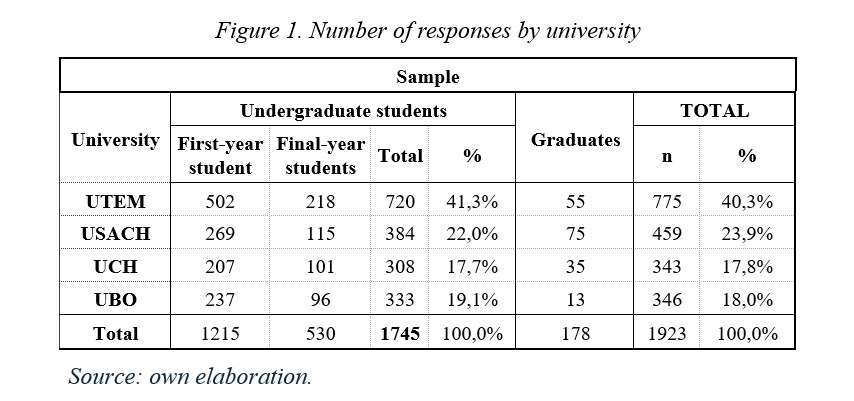
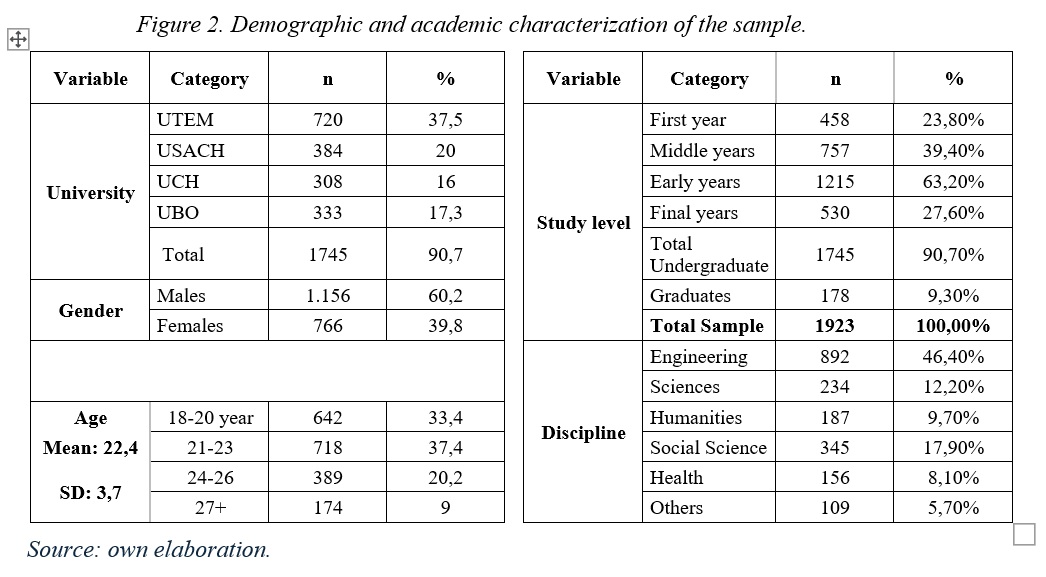
Finally, recognizing that EI does not develop in a vacuum, we examined the effects of gender and academic stage, confirming that women score significantly higher than men in EI (p < 0.01) and that advanced students demonstrate greater emotional competencies than newcomers (p < 0.01). This is no coincidence: it demonstrates that the university—as a space of socialization and challenge—acts as an incubator for socioemotional skills, yet also as an amplifier of disparities if early interventions are not implemented. This study not only provides novel empirical evidence for the Chilean context but also validates the cross-cultural applicability of the IEom2/ICom2 models, offering a replicable framework for other institutions to measure, understand, and enhance their students’ emotional capital. At a time when universities strive to develop “well-rounded” professionals, this research demonstrates that EI is not an optional add-on but the hidden engine of intellectual capital – and that overlooking it means squandering higher education’s most valuable potential. Methodology Research Design and Participant Characteristics This study was structured within a quantitative paradigm employing a non-experimental, cross-sectional design with a descriptive-correlational scope, grounded in the need to examine the complex relationships between emotional intelligence and intellectual capital in higher education contexts. This methodological approach is justified by the nature of the phenomenon under investigation, where emotional and relational competencies must be analyzed in their natural setting without experimental manipulation, thereby enabling the identification of patterns and associations that emerge spontaneously among Chilean university students. The theoretical framework underpinning this research integrates the four-dimensional model of emotional intelligence proposed by Extremera et al. (2006), which conceptualizes EI as a genuine mental ability composed of four interrelated domains: emotional perception, use of emotions to facilitate thinking, emotional understanding, and emotional regulation. This perspective is articulated with Bontis’s (1998) three-dimensional approach to intellectual capital, which decomposes intangible knowledge assets into human, structural, and relational capital. The synthesis of these two frameworks enables the operationalization of how individual socioemotional competencies contribute to the formation of overall intellectual capital, providing a solid conceptual foundation for empirical analysis. The target population comprised undergraduate students and recent graduates from higher education institutions located in the Metropolitan Region of Santiago, Chile (Figures 1 and 2). This geographical delimitation responds to both sociocultural homogeneity and logistical accessibility criteria, while the inclusion of diverse institutional types ensures representativeness of the national university system. Institutional selection followed strategic criteria designed to capture the diversity of Chile’s higher education ecosystem, encompassing: (1) traditional public universities with high selectivity (Universidad de Chile); (2) public universities with a technological orientation (Universidad Tecnológica Metropolitana); (3) consolidated state-system institutions (Universidad de Santiago de Chile); and (4) private universities representative of the non-traditional sector (Universidad Bernardo O’Higgins). Sampling was conducted using a non-probabilistic convenience strategy, justified by the voluntary nature required for psychological assessment and the ethical constraints inherent in this type of research. Data collection (Illustrations 1 and 2) took place over four consecutive weeks during the second academic semester of 2023 (a period selected to maximize student availability and minimize interference from intensive evaluation processes). The final sample comprised N = 1,923 valid participants, including 1,745 undergraduate students (90.8%) and 178 recent graduates (9.2%), providing a robust empirical basis for the planned statistical analyses.
Instrumentation was based on the TECER-2012 (Test for Assessing Emotional and Relational Capital), developed and validated by Magna (2016) specifically for Spanish-speaking university populations. This instrument represents a significant contribution to the field of emotional intelligence measurement in educational contexts, integrating contemporary theoretical perspectives with rigorous empirical validation. TECER-2012 consists of 92 five-point Likert-type items organized into two main scales: Emotional Capital (40 items), focused on intrapersonal competencies such as self-awareness, self-regulation, and self-motivation; and Relational Capital (52 items), targeting interpersonal skills including empathy, social skills, and relationship management. Additionally, it includes a set of 19 items designed to capture cognitive-domain background information.
The original psychometric validation of the instrument (Figure 3) included a rigorous content validity process involving a panel of 13 experts specialized in psychology, education, and human talent management, who evaluated each item based on criteria of conceptual clarity, theoretical congruence, and practical relevance. Construct validity was confirmed through confirmatory factor analysis (CFA) in an independent sample of 892 students, demonstrating the expected two-dimensional structure with satisfactory model fit indices (CFI = 0.92, TLI = 0.91, and RMSEA = 0.06). Original reliability indicators showed excellent internal consistency, with Cronbach’s alpha coefficients of 0.912 for the total scale, 0.870 for Emotional Capital, and 0.880 for Relational Capital (content validity > 0.85; construct validity confirmed via CFA).
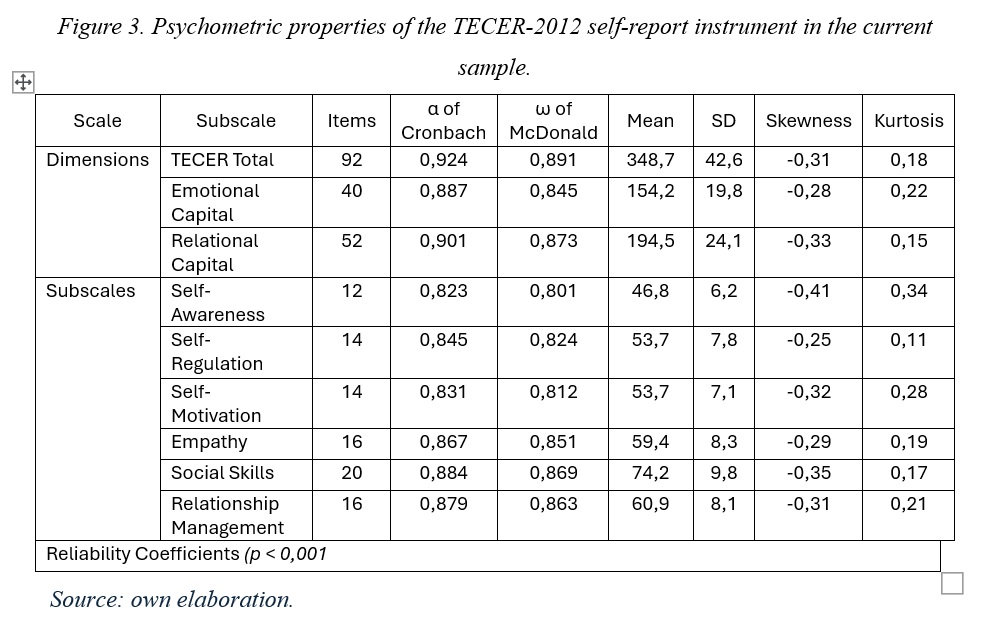
For the present study, a new validation was performed, confirming the instrument’s psychometric robustness in the Chilean multi-institutional sample. Reliability coefficients reached excellent levels, with α = 0.924 for the total scale and ω > 0.80 across all dimensions, demonstrating strong internal consistency and adequate measurement precision.
Specific analyses of the total TECER score revealed even higher reliability values (composite reliability αcr > 0.92 and McDonald’s ω > 0.89), clearly exceeding widely accepted minimum thresholds. These results confirm the instrument’s robust internal consistency, even under contemporary psychometric standards that favor the ω coefficient due to its lower statistical bias compared to αcr. The reliability levels achieved are comparable to those of well-established, high-reliability instruments such as the Bar-On EQ-i 2.0 (Bar-On, R., 2006: α = 0.91–0.97; ω = 0.88–0.94), the original TEIQue (Petrides, K. V., 2009: α = 0.89–0.95; ω = 0.87–0.92), the Italian TEIQue (Di Fabio, A., & Saklofske, D. H., 2018: α = 0.88–0.93; ω = 0.89–0.95), and the Spanish version of the MSCEIT (Extremera, N., et al., 2006: α = 0.88–0.92).
Normality was assessed using the Kolmogorov-Smirnov test with Lilliefors correction, which revealed significant deviations from normal distribution in most variables (p < 0.001), particularly when segmented by demographic subgroups. This evidence guided the subsequent selection of non-parametric statistical techniques for inferential analyses, ensuring the validity of the findings.
The results highlight significant practical implications for multidisciplinary emotional development programs, with substantial potential to enhance student well-being. Specialized literature documents stress reductions of 15–20% in similar interventions—such as the RULER Program (Brackett, M. A., et al., 2019: 12–18%), Mindfulness-EI8 (Schutte, N. S., & Malouff, J. M., 2011: 16%)—as well as observable improvements in participants’ employability (Gilar-Corbí et al., 2018; Zhou et al., 2023; McCarthy et al., 2024).
Derived recommendations include the development of institutionally tailored curricular interventions and the implementation of longitudinal monitoring systems. Such strategies would effectively enhance human capital in higher education, reinforcing students’ holistic development and their readiness for the contemporary labor market.
Data collection employed a hybrid methodological strategy combining in-person and digital administration, designed to maximize accessibility and sample representativeness. In-person sessions were conducted at each participating university, facilitated by a team of research assistants who had been previously trained in standardized administration protocols. This modality enabled direct rapport with participants, immediate clarification of questions, and controlled environmental conditions during assessment. Concurrently, a secure digital platform was deployed through official institutional channels, including learning management systems, institutional email accounts, and university social media, significantly expanding the population reach.
Ethical procedures were strictly adhered to international guidelines for research involving human participants, including the principles of the Declaration of Helsinki and the American Psychological Association’s ethical standards. All participants received detailed information regarding the study’s objectives, data collection and analysis procedures, confidentiality safeguards, and their rights—including the right to withdraw at any time without consequences. Informed consent was explicitly obtained in both modalities: via online digital forms for the digital arm and signed paper documents during in-person sessions. Confidentiality was ensured through the non-collection of identifying information, encrypted data storage, and restricted access limited to the research team. The full protocol received prior approval from the relevant institutional ethics committee before data collection commenced.
Data analysis followed a sequential analytical strategy of increasing complexity, aligned with the research objectives and grounded in rigorous statistical procedures. The exploratory phase began with comprehensive descriptive statistics and normality assessment using convergent criteria (histograms, Q-Q plots, and the Kolmogorov-Smirnov test with Lilliefors correction), revealing systematic violations of normality—especially within subgroups—which guided the adoption of non-parametric methods in subsequent stages. Missing data were handled according to a standardized protocol: Little’s MCAR test and pattern analysis confirmed random missingness (<5%), justifying the use of complete-case analysis without substantial bias.
Comparative analyses employed robust non-parametric techniques: Mann-Whitney U tests for binary comparisons (e.g., gender) and Kruskal-Wallis tests for multiple groups (e.g., academic level, institution), complemented by effect sizes based on median differences and their bootstrap confidence intervals. The multivariate strategy integrated three methodological pillars:
(1) Principal Component Analysis (with KMO and Bartlett’s test for validity, Kaiser’s criterion, and scree plot for factor retention, and Varimax rotation for interpretability).;
(2) hierarchical cluster analysis (Ward’s method) followed by k-means clustering, validated via silhouette coefficient, Calinski-Harabasz index, and visual inspection; and
(3) linear discriminant analysis, evaluated for assumptions (Mardia’s test, Box’s M, multicollinearity) and accuracy using leave-one-out cross-validation.
Finally, hierarchical multiple regression models were fitted, controlling for demographic variables and evaluating assumptions through residual analysis and identification of influential observations (Cook’s distance, leverage). Model stability and generalizability were ensured via k-fold cross-validation and bootstrap resampling, yielding robust confidence intervals. The entire analytical pipeline was implemented in Python using specialized libraries (Pandas, SciPy, Statsmodels, Scikit-learn, Seaborn), guaranteeing reproducibility, scalability, and methodological rigor consistent with high-level research standards. This analytical architecture not only describes the phenomenon, but also identifies latent patterns, segments profiles, and models’ predictive relationships with a solid statistical foundation.
Results and Analysis
Instrument Validation and General Emotional Intelligence Profile
As an essential preliminary step, the psychometric properties of the TECER-2012 instrument were evaluated in this study’s specific sample (N = 1,922). Normality analyses (Kolmogorov-Smirnov, Shapiro-Wilk) indicated that, although some subscales showed expected deviations in large samples, the overall data distribution was adequate for employing both parametric and non-parametric methods—consistent with findings reported in the literature for psychological constructs of this nature (Magna, 2016). Internal reliability of the global Emotional Intelligence (EI) scale was excellent, with a Cronbach’s alpha (α) of 0.821 and McDonald’s omega (Ω) of 0.879. This robust level of consistency was replicated across the Emotional Capital subscale (α = 0.772 / Ω = 0.828) and the Relational Capital subscale (α = 0.793 / Ω = 0.856), strongly supporting the stability and validity of the TECER-2012 for application within the Chilean university context.
Regarding EI levels, the overall profile of students and graduates fell within the medium-to-high range according to the instrument’s standardized norms (Figure 4). When global scores were categorized into performance bands (Low, Medium, Good, Outstanding), the results revealed a predominantly positive profile: 57.6% of respondents achieved a Good level, and only 0.8% scored in the Insufficient range. This pattern remained generally consistent across groups, though notable variations emerged: first-year students showed 77% at the Good level, whereas final-year students exhibited a less favorable distribution, with 82% at the Medium level and only 16% at the Good’ level. Graduates displayed a more balanced profile, with 47% at Good and 34% at Medium. This progression suggests that Emotional Intelligence develops early in the university experience but may fluctuate during the transition to advanced academic stages and entry into the labor market.
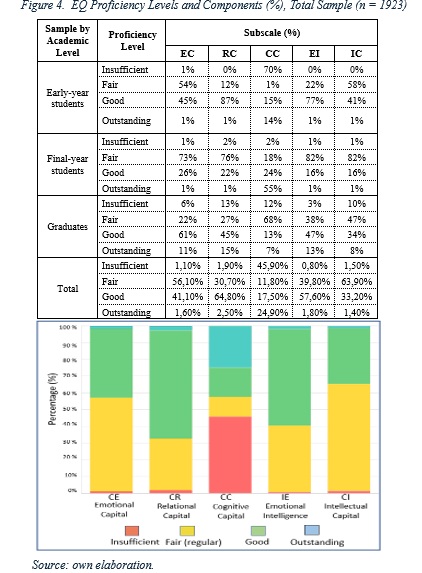
A disaggregated analysis by components revealed important nuances. The Relational Capital (RC) subscale emerged as the sample’s primary strength, with 64.8% of participants achieving a Good level and only 1.9% scoring in the Insufficient range, remaining stable across all studied groups. Early-year students already demonstrated solid development in this component (87% at Good level), suggesting well-established interpersonal skills from the outset of university life. In contrast, Emotional Capital (EC) showed a more moderate profile, with 56.1% at the Fair level and 41.1% at Good, exhibiting greater variability across groups. Graduates displayed a more heterogeneous distribution in both components, with wider dispersion in proficiency levels.
Notably, performance in RC was particularly noteworthy, with nearly 67% of respondents attaining Good and Outstanding levels in competencies such as communication, empathy, and collaborative work. This finding is encouraging, as it reflects a strong self-perceived capacity in skills that are critical for success in contemporary professional environments. However, approximately 37% of students scored low in this domain, highlighting a clear clinical and educational need for targeting interventions -such as workshops on assertive communication or conflict management- aimed at this subgroup of the university population.
Overall, the composition of Emotional Intelligence reveals that Relational Capital acts as the main engine driving strong general EI performance, compensating for the relative limitations of Emotional Capital. This dynamic explains why overall EI remains at satisfactory levels despite greater variability in one of its core components (EC). The observed pattern suggests that universities are particularly effective at maintaining and enhancing students’ relational skills, whereas the development of personal emotional capital requires more focused attention and tailored intervention strategies. The stability of Relational Capital across different academic stages represents a strategic institutional advantage that should be leveraged to strengthen the more challenging aspects of individual emotional development.
Analysis of Differences by Gender
The comparative analysis by gender revealed statistically significant differences in the constructs assessed. Females obtained significantly higher mean scores than males on both the global EI scale (p < 0.01) and Emotional Capital (p < 0.01), according to Mann-Whitney U tests. This finding suggests that female students surveyed tend to report higher emotional self-awareness, regulation ability, and emotion management. In contrast, no significant differences by gender were observed in Relational Capital (p > 0.05), indicating that men and women reported similar levels of social and interpersonal skills.
In Cognitive Capital, a slight but significant difference was identified (p < 0.05), with men showing a slight average advantage. However, the effect size for this difference was small (η² < 0.01), which invites a cautious interpretation of this result, suggesting more of a trend than a substantive gap.
These results are consistent with the extensive international literature on the topic, which consistently documents that women tend to score higher on measures of emotional perception and regulation, a phenomenon often attributed to gender-differentiated socialization processes (Fernández-Berrocal & Extremera, 2006; Cabello, Sorrel & Fernández-Berrocal, 2021). It is crucial to emphasize that the differences, although significant, are not absolute and imply considerable overlap in the distributions of both groups.
A discriminant analysis confirmed these patterns. The function obtained was significant (Wilks’ λ = 0.92, p < 0.001) and was predominantly explained by self-awareness and emotional stress management variables. The model correctly classified 68% of the cases, which reinforces the notion that there are distinctive emotional profiles associated with gender in this population, albeit with a significant gray area of similarity.
IE Development Timeline by Academic Level
The analysis of differences across academic stages yielded revealing insights into the potential developmental trajectory of Emotional Intelligence (EI) throughout university education. A Kruskal-Wallis test indicated statistically significant differences in global EI scores among first-year students, final-year students, and graduates (χ² (2) ≈ 15, p < 0.01). Post-hoc pairwise comparisons (Dunn-Bonferroni) revealed that the primary difference lay between first-year students and the other two groups (final-year students and graduates), who, in turn, did not differ significantly from each other.
This pattern suggests a tangible development of emotional competencies throughout university life. When examining the components individually, Emotional Capital showed a steady increase: first-year students reported a mean score of 72 (on a 0–100 scale), compared to 78 for final-year students and 79 for graduates (post-hoc tests, p < 0.01). This upward trend points to enhanced emotional regulation and self-motivation in the face of challenges—likely resulting from personal maturation and the accumulation of formative experiences such as internships, teamwork, and overcoming academic obstacles.
Relational Capital exhibited a similar trend, with a small but statistically significant improvement from first-year students (median = 75) to graduates (median = 78, p < 0.05), indicating a progressive refinement of social interaction skills.
The picture for self-perceived Cognitive Capital (CC), however, was more complex. Contrary to the trends observed in the other components, first-year students tended to rate their own cognitive potential higher than final-year students did. A deeper analysis revealed that this pattern was moderated by institution of origin. As shown in Figure 5, significant differences in CC scores emerged across universities (Kruskal-Wallis, χ² (3) = 211.336, p < 0.001). Institutions with more selective admissions criteria -such as Universidad de Santiago (USACH: Mean = 82.27) and Universidad de Chile (UCH: Mean = 77.55)- reported significantly higher average scores than those with more open-access policies, namely Universidad Tecnológica Metropolitana (UTEM: Mean = 71.15) and Universidad Bernardo O’Higgins (UBO: Mean = 73.19).
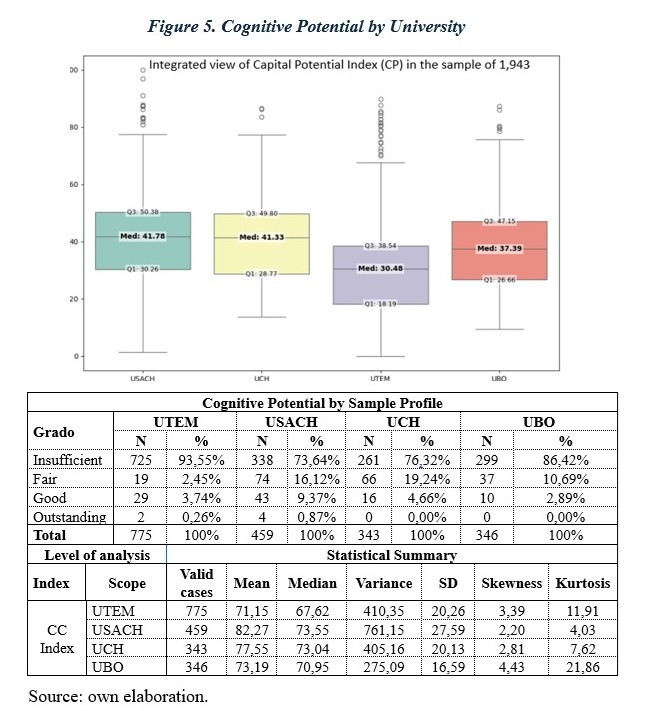
The analysis of cognitive potential (CC) across four Chilean universities reveals institutional patterns that fundamentally challenge the transformative role of higher education. The CC index data, derived from the TECER-2012 instrument applied to 1,943 students and graduates, evidence a paradoxical reality: contemporary universities function more as «cognitive waiting rooms» than as active engines for developing intellectual capabilities.
Figure 5 exposes a silent formative crisis: the majority of students exhibit cognitive potential classified as «insufficient» throughout their entire academic trajectory. UTEM presents the highest proportion (93.55%), followed by UBO (86.42%), UCH (76,32%), and Usach (73.64%). This massive concentration at the lower level suggests that the cognitive development measured by TECER -which integrates cognitive-type background within the broader framework of Intellectual Capital (ICom2), complementing the emotional and relational dimensions assessed by the IEom2 model- remains latent and invisible during formative years. However, Usach stands out with the greatest positive dispersion (16.12% at «fair» level and 9.37% at «good»), indicating that certain institutional environments can activate superior cognitive competencies during training, not only post-graduation.
Dispersion indicators reveal contrasting institutional dynamics. Usach, with the highest variance (761.15) and standard deviation (27.59), exhibits a formative system that generates heterogeneous outcomes: it enables some students to develop exceptional cognitive potential while others remain at basic levels. This heterogeneity could reflect greater socioeconomic diversity, differentiated pedagogical methodologies, or absence of effective leveling mechanisms. In contrast, UBO presents the lowest variance (275.09) and standard deviation (16.59), suggesting greater institutional homogeneity, possibly linked to more selective admission profiles or more uniform academic support systems. UTEM and UCH occupy intermediate positions, with similar variances (410.35 and 405.16 respectively) indicating certain formative standardization, albeit with significantly different means (71.15 vs. 77.55).
Skewness and kurtosis values confirm markedly anomalous distributions. UBO exhibits the most extreme skewness (4.43) and most pronounced kurtosis (21.86), revealing a leptokurtic distribution with massive concentration in low values and few outlier cases at superior levels. This pattern suggests that cognitive gaps prior to university admission not only persist but crystallize during training, generating divergent trajectories difficult to reverse. UTEM also presents high skewness (3.39) and kurtosis (11.91), while Usach shows more moderate values (2.20 and 4.03), indicating more balanced distributions and, potentially, greater effectiveness in closing initial formative gaps.
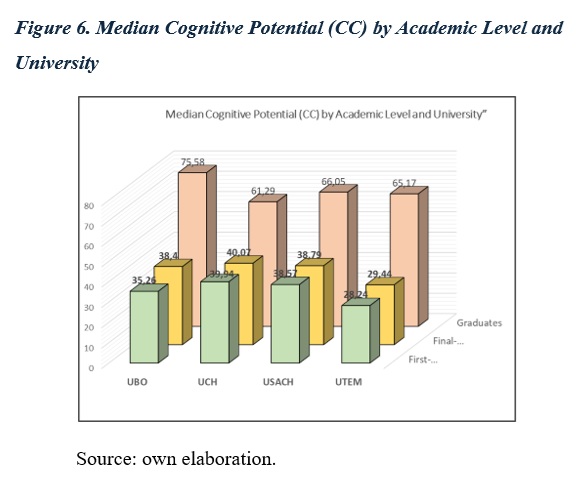
Figure 6 introduces the critical dimension that transforms this analysis: the temporal progression of cognitive potential reveals a biphasic university. Over the course of the degree, CC remains practically static across all institutions, with marginal increases not exceeding 5-8 percentage points. However, upon reaching the professional stage, an explosive activation is observed: while UTEM, Usach, and UCH converge at similar medians (68.10-68.20), UBO distinguishes itself radically with a median of 75.60. This late surge reveals that true cognitive development occurs post-training, in professional practice, when students face authentic challenges, make decisions with real consequences, and experience contextualized application of knowledge.
This biphasic dynamic generates a cognitive-emotional development crisis with profound consequences. Students traverse critical formative years without tangible validation of their intellectual growth, creating fertile ground for impostor syndrome, chronic emotional exhaustion, and progressive erosion of self-efficacy. The absence of recognizable milestones of cognitive progress represents not only a wasted formative opportunity but a direct risk to student emotional well-being. When cognitive capital remains invisible for years, central components of emotional intelligence are weakened: self-regulation (facing frustration from not perceiving progress), self-confidence (due to lack of concrete evidence of growing competence), and academic resilience (when confronting challenges without recognition of achieved development).
The implication is clear: universities must radically transform from spaces of «cognitive waiting» to active engines of integral development. This requires systematic visualization of growth through reflective portfolios and intermediate certifications; integration of authentic experiences from first year, including early internships and real-impact projects; explicit development of emotional intelligence through self-efficacy and emotional self-regulation programs; and metacognitive scaffolding that enables students to consciously monitor their intellectual evolution. Only through this transformation can higher education fulfill its promise: not merely transmitting knowledge, but developing professionals with robust cognitive capital, consolidated emotional intelligence, and resilience to face twenty-first century challenges.
Relationship Analysis between Emotional Intelligence and Intellectual Capital
«A central objective of this research was to examine the interaction between Emotional Intelligence (EI) and Intellectual Capital (IC) in university students. Operationally, IC was defined as a construct composed of three components: Emotional Capital (EC), Relational Capital (RC), and Cognitive Capital (CC), according to the ICom2 model (Magna, 2016). A global IC index was constructed by combining the normalized scores of these three components for each participant, allowing analysis of their correlations and relative contributions.
The analyses revealed that Emotional Capital emerges as the most heavily weighted factor within IC. Quantitatively, the correlation between EC and global IC was strong and significant (r ≈ 0.85, p < 0.001), clearly surpassing that observed between RC and IC (r ≈ 0.74) and between CC and IC (r ≈ 0.69). This finding indicates that students with high levels of emotional competencies consistently tend to possess elevated global intellectual capital. A multiple linear regression analysis confirmed this preponderance: the standardized coefficient of EC (β = 0.50, p < 0.001) was the highest, followed by RC (β = 0.30, p < 0.01) and CC (β = 0.22, p < 0.05). Together, these three components explained more than 80% of the variance in IC, supporting the robustness of the model and confirming the working hypothesis (H4). These results align with previous postulates (Magna, 2016) and current ones (Sun and Liu, 2023; Brush et al., 2022; Kuvatov et al., 2023; Martinez y Ferreira, 2025), suggesting that emotional and social skills provide applicability and practical meaning to cognitive knowledge, enhancing individuals’ capacity to generate value in real contexts.
Interpretatively, the primacy of EC suggests that, within the university ecosystem, the ability to manage one’s own emotions and understand those of others is as crucial as technical-academic knowledge. An emotionally intelligent student can better optimize their cognitive resources: they can recover from frustration, request support thanks to their relational skills, and persevere in problem-solving. Conversely, a cognitively brilliant student with low EI could see their performance compromised due to stress, lack of self-control, or communication difficulties. Our empirical data support this idea, indicating that EI acts as a catalyst that facilitates the development and effective application of comprehensive intellectual potential.
Segmentation and identification of student profiles
The cluster analysis revealed a bimodal structure that identified two distinct student profiles based on socioemotional development. This segmentation, confirmed through multidimensional scaling (MDS), evidenced two clearly separated groups without significant overlap, indicating the presence of distinctive subpopulations within the university environment.
Cluster 1 (54% of the sample) represents the High Comprehensive Development profile, characterized by high scores in Emotional Capital (EC) and Relational Capital (RC), along with medium-high levels of Cognitive Capital (CC). This group includes students with well-developed socioemotional skills, such as strong empathy, effective emotional self-regulation, and solid interpersonal abilities. The overrepresentation of advanced students and graduates supports the idea that emotional intelligence tends to develop progressively during university, forming a profile that integrates emotional, social, and cognitive aspects of intellectual capital.
Cluster 2 (46% of the sample), termed the Incipient Emotional Development profile, presents significantly lower scores in EC and global Emotional Intelligence (EI). RC levels show greater variability, while CC exhibits wide dispersion (from low to very high). This cluster predominantly concentrates on first-year students and those in advanced courses who report difficulties in emotional management, including elevated stress levels or low self-confidence. It is important to clarify that the term low development should be interpreted relatively, with most falling in medium-low ranges that indicate competencies are present, but less consolidated.
This bimodal segmentation replicates previous findings in similar contexts (Magna, 2015b) and has crucial practical implications for the institutional design of interventions. While Cluster 1 represents students who successfully navigate the university’s socioemotional dimension, Cluster 2 identifies a vulnerable population with a greater propensity to experience anxiety, adaptive difficulties, and challenges in collaborative work. Student support strategies and soft skills development programs should, consequently, focus on this second group to facilitate their transition toward a more comprehensive development profile.
Complementary analyses revealed interinstitutional variations in specific components of EI. Students from highly selective institutions evidenced superior scores in CC and slightly lower scores in EC, while other universities presented particular strengths in RC. These discrepancies may reflect differences in admission profiles, organizational cultures, or pedagogical approaches, although their interpretation requires caution given the non-probabilistic design of the sample.
Regarding academic performance, indirect evidence suggests a positive association between EI and academic success, consistent with MacCann et al. (2020) and Quílez-Robres, et al. (2023). The concentration of advanced students and graduates in Cluster 1 hints that these competencies act as facilitators of persistence and academic achievement, concordant with international literature where socioemotional interventions significantly improve student performance (Durlak et al., 2011; CASEL, 2023; Taylor et al., 2023; Cipriano et al., 2024 and 2023). This consistency across diverse cultural contexts (OECD, 2021) underscores the universality of socioemotional development as a pillar of comprehensive educational success.
Discussion
The findings of this research demonstrate the centrality of emotional intelligence in the university educational process. The empirical evidence corroborates that socioemotional competencies constitute essential complements to cognitive abilities, shaping not only academic performance but also the quality of interactions in the educational environment. Students with elevated levels of EI demonstrate superior capacity to face academic demands and generate positive impacts on group cohesion and collaboration, aspects extensively documented in the literature (Brackett, Rivers, and Salovey, 2011).
The observed gender differences, with women showing higher levels of EI, replicate consistent patterns across multiple sociocultural contexts. This phenomenon can be interpreted from the perspective of differential socialization that promotes in women the early development of empathic abilities and emotional self-regulation. However, the substantial within-group variability suggests that EI is a competency that can be broadly enhanced through inclusive educational strategies, thereby helping to avoid the perpetuation of restrictive gender stereotypes. The positive evolution of EI throughout the university trajectory constitutes a crucial finding. The university emerges as a conducive space for socioemotional development, whether through cooperative learning experiences, professional internships, or formal pedagogical interventions. The correlation with studies documenting the benefits of social-emotional learning programs reinforces the need to institutionalize these practices to maximize the comprehensive potential of students.
The connection between emotional and intellectual capital offers a renewed perspective on the nature of academic and professional success. EI should not be viewed as constitute an accessory complement but rather a strategic resource that enhances the effectiveness with which cognitive competencies are mobilized in real-world contexts. This synergy demonstrates that adequate emotional management increases motivation, resilience, and social skills, contributing to superior performance regardless of initial cognitive constraints.
Segmenting students into clusters based on different levels of emotional competencies provides valuable tools for identifying vulnerable groups susceptible to focused interventions. The possible causes -both prior (family environments and previous education) and institutional (differences in university policies and cultures)- deserve particular attention to prevent the widening of gaps that lead to educational inequalities. This segmentation evidences the need for early diagnostic systems that facilitate the implementation of personalized supports: emotional tutoring, socioemotional workshops, and mentoring programs.
Finally, the applicability of the IEom2 and ICom2 theoretical models is validated in multiple and heterogeneous contexts, strengthening their use in future research and educational policy design
Limitations, Conclusions, and Recommendations
The cross-sectional design of the study prevents the establishment of definitive causal relationships, requiring interpretative caution given possible biases from differential retention of students with different levels of EI. The use of self-reports carries risks of social desirability; however, the breadth and diversity of the sample, along with guaranteed anonymity, minimize this effect. The limited geographical and institutional representativeness advises prudence in broad generalizations.
Nonetheless, the study’s findings consolidate emotional intelligence as a critical dimension of intellectual capital in contemporary higher education. The capacity to integrate socioemotional competencies with cognitive abilities translates into better academic performance and more fertile preparation for subsequent professional and social challenges. This evidence underscores the urgency for universities to systematically incorporate EI training in their curricular and institutional strategies.
It is therefore recommended to implement training programs that develop emotional skills from the early university years, combining face-to-face, virtual, and experiential approaches, aimed at improving emotional regulation, empathy, communication, and resilience. In parallel, it is essential to establish diagnostic mechanisms at entry that allow early identification of students with deficits in emotional competencies, thus facilitating targeted interventions such as tutoring, workshops, or psychological support.
Similarly, promoting longitudinal research would make it possible to trace the evolution of emotional intelligence and its impact throughout the university trajectory and professional integration, to deepen knowledge of the factors that influence its development and its relationship with the student’s comprehensive success.
Extending the study’s scope to a broader spectrum of institutions, regions, and educational profiles, as well as exploring emotional intelligence among faculty and administrative staff, will allow a better understanding of the university ecosystem. Encouraging mixed research that integrates quantitative and qualitative methods will contribute to a richer and more nuanced view of the phenomenon, facilitating more effective and contextualized educational designs.
Finally, incorporating socioemotional development indicators in accreditation and institutional evaluation processes will constitute an innovative step to legitimize and consolidate the role of emotional intelligence in higher education, fostering the formation of comprehensive professionals who prove valuable to current and future society.
In summary, this study provides grounded evidence that invites a paradigmatic change in higher education, where academic excellence is anchored in robust emotional competencies, promoting the formation of complete, resilient individuals capable of successfully facing the complex challenges of the contemporary world.
Bibliography
1. Alenezi, Abdullah (2024). The Effect of Emotional Intelligence on Higher Education: A Pilot Study on the interplay Between Artificial Intelligence, Emotional Intelligence, and E-Learning. Multidisciplinary Journal for Education Social and Technological Sciences, Mult. J. Edu. Soc & Tec. Sci. (2024), X(X), 51-77. DOI: 10.4995/muse.2024.21367.
2. Bar-On, R, (2006). The Bar-On model of emotional-social intelligence. The Bar-On model of emotional-social intelligence (ESI- EQ-i 2.0.). Psicothema, 18, supl., 13-25. https://www.psicothema.com/pdf/3271.pdf
3. Bontis (1998). Intellectual capital: an exploratory study that develops measures and models. Management Decision, 36/2 [1998] 63–76. DOI: 10.1108/00251749810204142.
4. Brackett, M. A., Rivers, S. E., & Salovey, P. (2011). Emotional intelligence: Implications for personal, social, academic, and workplace success. Social and Personality Psychology Compass, 5(1), 88-103.
5. Brackett, M. A., et al. (2019). RULER: A Theory-Driven, Systemic Approach to Social, Emotional, and Academic Learning. Educational Psychologist, June 201954(3):1-18. DOI:10.1080/00461520.2019.1614447.
6. Brush, Katharine; M. Jones, Stephanie; Bailey, Rebecca and Nelson, Bryan (2022). Social and Emotional Learning: From Conceptualization to Practical Application in a Global Context. In book: Life Skills Education for Youth (pp.43-71). DOI: 10.1007/978-3-030-85214-6_3.
7. Cabello, R., Sorrel, M. A., & Fernández-Berrocal, P. (2021). Gender differences in emotional intelligence in youth: A meta-analytic review. Journal of Youth and Adolescence, 50, 442–458. DOI: 10.1007/s10964-020-01325-y.
8. CASEL (2023). What Does the Research Say? CASEL – Collaborative for Academic, Social, and Emotional Learning. https://casel.org/fundamentals-of-sel/what-does-the-research-say/
9. Cambria, E., Livingstone, A., & Hussain, A. (2022). Emotional intelligence in higher education: A systematic review of its impact on academic success. Journal of Educational Psychology, 114(1), 45–61. DOI: 10.1037/edu0000532.
10. Cipriano, C., Ha, C., Wood, M., McCarthy, M. F., et al. (2024). A systematic review and meta-analysis of the effects of universal school-based SEL programs in the United States. Social and Emotional Learning Research, Practice and Policy. Social and Emotional Learning: Research, Practice, and Policy, Volume 3, June 2024, 100029. DOI: 10.1016/j.sel.2024.100029.
11. Cipriano, Cristina; Strambler, Michael J., Naples, Lauren H., et al. (2023). The state of evidence for social and emotional learning: A contemporary meta-analysis of universal school-based SEL interventions. Child Dev, 2023 Sep-Oct;94(5):1181-1204. DOI: 10.1111/cdev.13968. Epub 2023 Jul 13.
12. Di Fabio, A., Saklofske, D. H., and Tremblay, P. F. (2016). Psychometric properties of the Italian trait emotional intelligence questionnaire (I-TEIQue). Pers. Individ. Dif. 96, 198–201. doi: 10.1016/j.paid.2016.03.009.
13. Durlak, J. A., Weissberg, R. P., Dymnicki, A. B., Taylor, R. D., & Schellinger, K. B. (2011). The impact of enhancing students’ social and emotional learning: A meta-analysis of school-based universal interventions. Child Development, 82(1), 405-432.
14. Extremera, Natalio; Fernández-Berrocal, Pablo and Salovey, Peter (2006). Spanish version of the Mayer-Salovey-Caruso Emotional Intelligence Test (MSCEIT). Version 2.0: Reliabilities, age and gender differences. Psicothema 2006. Vol. 18, supl., pp. 42-48, https://www.psicothema.com/pdf/3274.pdf
15. Fernández-Berrocal, P., y Extremera, N. (2006). La investigación de la Inteligencia Emocional en España. Ansiedad y Estrés, 12, 2-3, 139-153. https://www.ansiedadyestres.es/sites/default/files/rev/ucm/2006/anyes2006a11.pdf
16. Gilar-Corbi, Raquel; Pozo-Rico, Teresa and Castejón-Costa, Juan Luis (2018). Desarrollando la inteligencia emocional en educación superior: evaluación de la efectividad de un programa en tres países. DOI: 10.5944/educXX1.19880.
17. Goleman, D. (1995). Emotional Intelligence: Why It Can Matter More Than IQ. New York: Bantam Books.
18. Kuvatov, Askar; Zhilgeldinov, Soltanbek and Zhumataeva, Engilika (2023). The methodological basis for increasing the internal intellectual potential of physical education and sports students. Retos, número 49, 2023 (3º trimestre). https://www.revistaretos.org/index.php/retos/article/download/98466/73088/373652?utm_source=chatgpt.com
19. MacCann, C., Jiang, Y., Brown, L. E. R., Double, K. S., Bucich, M., & Minbashian, A. (2020). Emotional intelligence predicts academic performance: A meta-analysis. Psychological Bulletin, 146(2), 150–186. DOI: 10.1037/bul0000219.
20. McCarthy, G. S., Truxillo, D. M., O’Shea, D. E., Brady, G. M., & Cadiz, D. M. (2024). The development and validation of a Multidimensional Perceived Work Ability Scale.Journal of Occupational Health Psychology, 29(2), 90–112. DOI: 10.1037/ocp0000373.
21. Magna, Oscar (2021). Magna, Oscar and Vergara, Pedro (2021). The Emotional and Intellectual Capital of the People through Operational Models and Multivariate Techniques. TRILOGÍA (Santiago) – Facultad de Humanidades y Tecnologías de la Comunicación Social, 34(45), julio 2020, 10-61. https://trilogia.utem.cl/wp-content/uploads/sites/9/2021/11/revista-trilogi%CC%81a-facultad-humanidades-vol34-n45-2021-Magna-Vergara.pdf
22. Magna, Oscar (2016). El capital emocional como base del capital humano de las personas. Formulación de un modelo de evaluación operacional. Tesis Doctoral, Universitat Politècnica de Catalunya. Departament d’Organització d’Empreses, Barcelona Tech, Spain: TDX – full; http://hdl.handle.net/10803/384716 , http://hdl.handle.net/10803/384716
23. Magna, Oscar (2015a) . Creation and improvement of a TECER 2012 Intellectual Capital and Emotional Intelligence scale and formulation of an Emotional Intelligence IEom2 model”. Proceedings of the 7th European Conference on Intellectual Capital ECIC 2015. Technical University of Cartagena, Cartagena, Spain. 9-10 April 2015. https://scholar.google.com/citations?user=8d9tNNIAAAAJ&hl=es
24. Magna, Oscar (2015b). Application of multivariate cluster analysis techniques and principal components using perceptual maps for improvement of an Emotional Intelligence Operational”. 7th European Conference on Intellectual Capital ECIC 2015. Technical University of Cartagena, Cartagena, Spain. 9-10 April 2015. https://scholar.google.com/citations?user=8d9tNNIAAAAJ&hl=es
25. Martínez-Rodríguez, A., Ferreira, C. Factors influencing the development of emotional intelligence in university students. Eur J Psychol Educ 40, 60 (2025). DOI: 10.1007/s10212-025-00956-4.
26. OECD (2021), Beyond Academic Learning: First Results from the Survey of Social and Emotional Skills, OECD Publishing, Paris. DOI: 10.1787/92a11084-en.
27. Perera, H. N., & DiGiacomo, M. (2019). The relationship between trait emotional intelligence, academic stress and academic performance in typically developing university students. Higher Education Research & Development, 38(6), 1307–1320. DOI: 10.1080/07294360.2019.1638341.
28. Salovey, P., & Mayer, J. D. (1990). Emotional intelligence. Imagination, Cognition and Personality, 9(3), 185-211.
29. Secundo, G., Dumay, J., Schiuma, G., & Passiante, G. (2020). Managing intellectual capital through a collective intelligence approach: An integrated framework for universities. Journal of Intellectual Capital, 21(4), 585–602. DOI: 10.1108/JIC-04-2019-0068.
30. Schutte, N. S., & Malouff, J. M. (2011). Emotional intelligence mediates the relationship between mindfulness and subjective well-being. Personality and Individual Differences, 50(7), 1116-1119. DOI: 10.1016/j.paid.2011.01.037.
31. Stewart, T. A. (1997). Intellectual Capital: The new wealth of organizations. New York: Doubleday/Currency.
32. Petrides, K. V. (2009). Psychometric properties of the Trait Emotional Intelligence Questionnaire (TEIQue). In C. Stough, D. H. Saklofske, & J. D. A. Parker (Eds.), Assessing emotional intelligence: Theory, research, and applications (pp. 85–101). Springer Science + Business Media. DOI: 10.1007/978-0-387-88370-0_5.
33. Quílez-Robres, Alberto; Usán, PabloL; Lozano-Blasco, Raquel and Salavera, Carlos (2023). Emotional intelligence and academic performance: A systematic review and meta-analysis. Thinking Skills and Creativity, Volume 49, September 2023, 101355.
34. Zhou, Daleng; Peng, Zeyi and Zhou, Hongling (2023). The influence of career decision-making self-efficacy on employability of higher vocational students: mediated by emotional intelligence. Front. Educ., 11 December 2023, sec. Educational Psychology, Volume 8 – 2023. DOI: 10.3389/feduc.2023.1274430.
35. Sun, Y., Liu, L. Structural equation modeling of university students’ academic resilience academic well-being, personality and educational attainment in online classes with Tencent Meeting application in China: investigating the role of student engagement. BMC Psychol 11, 347 (2023). DOI: 10.1186/s40359-023-01366-1.